Saturday, September 12, 2009

What's Keeping Kids Inside

With the constant push for making the grade on standardized tests, recess is being reduced and at times eliminated from the daily schedule. At our school, language arts fills two hours, plus 20 minutes for spelling and word study, then an hour for math. At least 30 minutes for social studies or science and lately science is being edged out altogether because it's not tested at all grade levels. Then there are specials - art, music, or PE and finally lunch. Sometimes there's just no room for recess.

At home, there's plenty to keep kids indoors. TV, video games, and computers take up a good deal of time. Our students live in an urban environment and parents don't feel it's safe to allow children to be outside unsupervised. Many children have a sedentary lifestyle and just don't have the interest in going outside. Because children haven't spent much time in unstructured play, they may not have the social skills necessary to play without an adult present. As a result, spending time enjoying nature is not a priority for parents or children.

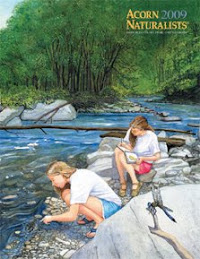
Outdoor education, whether in school or through special programs, teaches children how to get in touch with nature. They can learn science concepts through hands-on experiences in a natural environment, and most importantly, students can develop a life-long love of nature by learning about the life that is present there.

No Time for Recess

This week, first graders went into the school garden to collect samples of living things. Our mission was to define what living means. I was very careful to teach and demonstrate how to gather the living things. If students wanted to collect a leaf, I showed them it was best to take one from the ground instead of pulling it from the plant. If students wanted an insect in their collection, I said look for one that was already dead instead of taking a live specimen.

The children did an excellent job in collecting their samples. Once in the classroom, the student partners, spread their examples on the carpet in a neat row. We talked about why these things would be classified as living. They said things like-- they grow, they change, and they need air, light, and food. One student said, living things don't have to be green. Another student said, they don't have to be plants. We were finally able to make a good definition of living things by sorting and classifying our samples from the garden.

When I was about the leave the class, the teacher pulled me aside and whispered--"They're just so happy to be able to go outside. Thank you! On Tuesdays we don't have time for recess!" Not only do living things need light and air, but so do six year olds! I think outdoor education not only teaches important science and ethical concepts, but it takes kids outside, into the natural environment to stay in contact with nature and teaches them how to love it gently and respectfully.

Monday, August 10, 2009

Assignment 1: First Graders Observe the Garden

When Emily suggested that she wanted her first graders to work in the school garden this year, I was SO excited! At last I had a teacher who was not only interested but willing to initiate outdoor learning. As a teacher who's main goal it is to invite students to inquire and think through the lens of science, I was ready, willing, and able to make this happen.

Last week, we had our first class together. The students sat before me in the classroom and I told them we were going to learn like scientists this year and find out about nature. We would use our school garden to see what we could find out. I told them that today we would go out into the garden with a clipboard, a sheet of paper, and a pencil and record what we could find. The kids were wide-eyed. This was going to be exciting!
I made a chart that said, "What is in our garden?" I made a t-chart and on one column wrote, "predictions". I said, this is a good guess about what we might find out there. When we come back we'll see if we were on the right track. We made our predictions-- rocks, ants, earthworms, dirt, flowers, bees, etc...
Each student carried their own materials. (We made sure to bring extra pencils-just in case.) We walked to our garden and circled around it. The kids began talking excitedly about what they were seeing. I pointed out an acorn, a dead beetle, and they busily pointed out many other things. The students sketched and wrote on their papers. They got in small groups or partners to share out loud what they were seeing. The teacher seemed a little nervous about all the talking, but I said-- this is exactly what we want. They are talking about their findings. It's perfectly scientific!

We got back into our line and walked to the classroom. We compared our observations with our predictions. I made check marks on our predictions that matched our observations and added new things we hadn't thought of. We talked about how it was ok to not know something but to find it out. It was an exciting science experience and good groundwork for our future explorations and investigations in the schoolyard garden.

Saturday, August 1, 2009

Outdoor Classroom at My School

This week a couple new developments have occurred about the use and improvement of our outdoor classroom. I was having a conversation with a first grade teacher and she said that she wanted her students to actually go outside to use the garden beds to learn about the plant life cycle. Of course, this really excited me, so I volunteered to help her and use our collaboration time in science to do this together. Wow!

Then I shared this with other first grade teachers and they were on board, too. The garden beds have been laying dormant for at least two years. This authentic, hands-on learning will be great for the kids and will provide a rich learning experience.

On top of that, the principal asked me if I would be interested in coordinating the outdoor gardening area for the school. I happily agreed. But that's not all! She said that improvements were in the works and that we were going to be providing tables for kids to use outside and other things. She asked if I'd like to work with the outdoor crew on that and I said YES! I was ready to sit down and write a Lowes' Grant for tables, benches, and gardening tools, but now maybe I don't have to. It's starting to come together. This is such a great turn of events. I have dreams of a beautiful and use-able outdoor classroom environment!

Back to School and the Topic is Science Notebooks

It was a wonderful first week at school. After attending MEMTA, I felt so energized and inspired to bring inquiry-based science to our school and if not the school, well at least MY classroom!

This week I began sharing some of my experiences from the academy. I decided to start with notebooks because, as I found out, they are a great tool for kids to develop their thinking and understanding about what they're learning. I want out science notebooks to be student-centered.

Hopefully we can get away from copying or cutting and pasting ready made notes. I'd like this to be the place where kids formulate their own thoughts, predictions, and findings.

I'm also thinking a lot about the 5 E's structure for lesson planning-- engage, explore, explain, elaborate, and evaluate. There's a really good handout that explains this showing teacher behaviors and student behaviors. Go to http://www.tvdsb.on.ca/currscielementary/smarter_science/Stage_2/5E%20Summary%20Chart.pdf to learn more.

This is all very exciting, but the proof will be in the student achievement outcome. Our science scores were really low for the last few years. Science should be loved by all kids and they should excel at it. Obviously what we're doing should change. We can do so much more to bring science learning to the kids. I'm hoping this will be the beginning of that change.

Sunday, July 19, 2009

From Texas Prairies to the New Jersey Skyline

This week I am attending the Michelson ExxonMobil Teachers Academy in Jersey City, New Jersey. We will be attending classes at the Liberty Science Center. According to Phil Mickelson, our benefactor, "The Academy is an opportunity for teachers to share best practices with colleagues and pick up tools to positively impact the science and math education students receive."

Right now I am sitting in a beautiful room at the Hyatt overlooking the Hudson River with a view of NYC. This is quite a difference from the flat lands of Texas or even the woodlands of Virginia. As the week progresses, I plan to share my reflections about what I'm learning. It's going to be an exciting week sharing knowledge with teachers from all over the United States. I'm looking forward to it!

Monday, July 13, 2009

My Home on the Range

Returning to my childhood home inTexas, I find myself looking out over the plains wistfully. I remember being on vacation as a child traveling the highways of Texas, it got pretty monotonous. Mile after mile, there was nothing but flat country. You could see all the way to the horizon without a single tree in sight. It seemed to go on forever.

Now those wide open vistas are getting rarer. Motels, restaurants, shopping malls, and housing developments are standing in the place where space used to be. That's sad. I now see that open space with new eyes. Hope it's not too late.

In my research to learn more about the Texas prairie, I discovered an organization to save it called The Great Plains Restoration Council. I found out that "The Fort Worth Prairie ecosystem is a subset of the once famous Southern Tallgrass Prairie. Tallgrass Prairie in general is the most endangered major ecosystem in North America. The Fort Worth Prairie, with perhaps 30,000 scattered acres remaining (was originally 1.3 million acres stretching from just south of the Red River down to Johnson County) is considered G1/G2 (Globally Imperiled)." Not surprisingly, these are endangered lands.

I also discovered that there are several universities in the area who are using this land as an outdoor classroom. This gives me hope and lends some assurance that being outside, learning from nature, is a way for students to become more knowledgeable through hands-on and authentic experiences. In my work with elementary school children in the outdoor classroom, it is my hope that they will both learn and come to love these wide open spaces. Wouldn't it be a shame if years from now when they are on vacation as I am, traveling across Texas, they find themselves saddened by the disappearance of the prairie? They'll turn and say, remember when it seemed to go on forever...